

Our Services
All the solutions you need to accelerate growth and drive business success.
All the solutions you need to accelerate growth and drive business success.
Shopify Services
Most ecommerce brands come to us not because the store is broken. They come because the store is disconnected. Fragmented data, too many apps doing the same job badly, and inventory that does not match what the business actually has.
Dotlogics works with corporate ecommerce teams whose Shopify stores are already live. The store itself is rarely the issue. What brings clients to us is what sits behind it: systems that do not talk to each other, apps that slow the store down without solving the underlying problem, and operations teams manually reconciling data that should flow automatically. That is what the engagement addresses.



Of software features are rarely or never used.
Standish Group Research
Across every platform category, the gap is rarely the software itself. It is an implementation that never matched the platform to how the business actually operates.
There is a pattern in ecommerce operations that grows more expensive the longer it goes unaddressed. The store is live, converting, and orders are coming in. The gap shows up in three consistent patterns.
Dotlogics audits the current store, maps the operational gaps, and builds what connects the store to the business behind it.
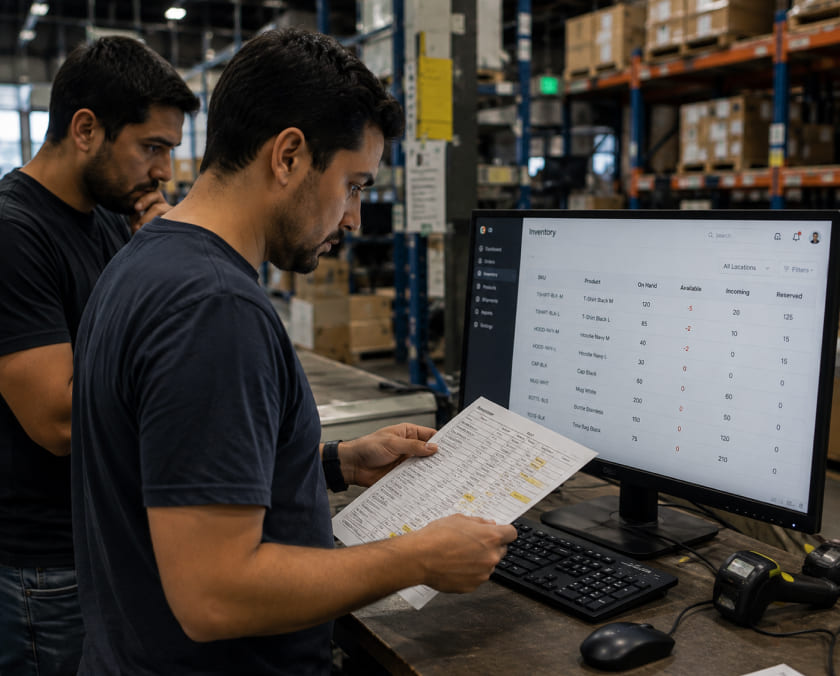
Fewer order fulfillment errors after connecting Shopify to the inventory and fulfillment operation behind it. That number reflects what happens when the system reflects real data instead of yesterday's export.
Every Shopify engagement starts with understanding how the business actually operates, not with a platform walkthrough.
Building what the business needs that does not exist in the theme or app store. Custom checkout flows, custom product configurators, custom sections, and any functionality the store requires that generic solutions cannot cover correctly.
Moving from WooCommerce, Magento, BigCommerce, or a legacy platform to Shopify without losing SEO and AI SEO rankings, order history, or customer data. The migration plan is built before anything moves.
Connecting Shopify to the ERP, CRM, inventory system, and fulfillment operation so that the store reflects real data and orders flow automatically to the right place without someone moving them manually.
Auditing the existing store and implementing changes that lift conversion based on data, not design opinions. Checkout, product pages, and purchase flow are where the most impactful changes happen.
These are not unusual situations. They show up in most stores that have been live for more than a year and grown faster than the initial setup was designed to handle.
The Shopify app ecosystem makes it easy to add functionality quickly. It also makes it easy to build a store running on 20 apps, each adding page load time and creating potential conflicts. Dotlogics audits the current app stack and replaces redundant or slow apps with custom solutions where the business case supports it.
Shopify's native inventory management works for simple operations. Brands with warehouses, multiple locations, and complex fulfillment need Shopify connected to a proper inventory or ERP system. Without that connection, overselling, stockouts, and manual reconciliation all become regular problems.
When the Shopify store is not connected to the inventory system, finance system, or fulfillment operation, the data the team sees is always behind. Decisions get made on incomplete information and the gap between what the store shows and what is actually true widens over time.
Moving to Shopify from another platform without a proper redirect strategy destroys organic traffic and AI search visibility. Every URL that changes without a redirect loses whatever ranking it had. Dotlogics maps all existing URLs before migration and implements redirects before the new store goes live, not after.
Results

Ecommerce Development
An outdoor sports brand selling seasonal products needed a Shopify store that could handle demand spikes, complex product variants, and direct connection to their fulfillment operation. After migrating to Shopify and integrating with their inventory and fulfillment systems, the store handled peak season traffic without degradation. Inventory accuracy improved significantly and order fulfillment errors dropped by 70%.
Almost always optimize first. A full rebuild is rarely the answer unless the current store is technically broken or on a framework that cannot be maintained. A conversion audit identifies the specific pages and flows where customers are dropping off and the changes that would have the most impact. Rebuilding without this data produces a new store with the same problems.
This is one of the most common Shopify problems for businesses with real operational complexity. The integration approach depends on the ERP. Some have native Shopify connectors. Others need a middleware layer or custom API integration. Dotlogics has built integrations between Shopify and Microsoft Dynamics, NetSuite, Odoo, and custom ERP systems. The right approach depends on the ERP, the transaction volume, and the real-time data requirements.
For most brands, yes. Magento's total cost of ownership is significantly higher than Shopify Plus when hosting, maintenance, security patches, and developer time are included. Shopify Plus at $2,500 per month covers hosting, security, and core platform maintenance. The migration requires careful planning for SEO and AI SEO preservation and data migration, but the long-term operational cost reduction is usually significant.
App sprawl is one of the most common performance problems on Shopify. The first step is an audit of every app, what it does, whether it is actually used, and whether it conflicts with other apps. Many brands are running apps that were installed years ago and no longer serve any function. Removing redundant apps and replacing high-impact ones with custom solutions usually produces meaningful page speed improvements.
SEO and AI SEO preservation in a Shopify migration requires mapping every existing URL to its new equivalent before any content is moved, implementing 301 redirects from old URLs to new ones, and verifying in Google Search Console that the new URLs are being indexed correctly. Brands that skip redirect mapping consistently lose organic traffic rankings and AI search visibility that can take months to recover. Dotlogics does this work before the new store goes live, not after.
The most meaningful difference is checkout source code access. Standard Shopify does not give access to the checkout source code. Shopify Plus does. This matters because checkout is where the most impactful conversion optimization happens. Shopify Plus also includes Shopify Flow for advanced automation, Launchpad for campaign scheduling, and native B2B selling capabilities. For businesses generating over roughly $1 million in annual online revenue, the return on Shopify Plus is usually clear.
A new Shopify store build typically takes 6 to 12 weeks depending on the level of custom development and integrations required. A migration from another platform typically takes 8 to 16 weeks, with the additional time going to data migration, SEO and AI SEO redirect mapping, and integration rebuilding. The timeline is confirmed after a discovery phase where the full scope is established.
Shopify Plus has native B2B capabilities including company accounts, customer-specific pricing, purchase order payment, and wholesale order management. Standard Shopify requires third-party apps to approximate these. For businesses with straightforward B2B requirements, Shopify Plus B2B is often sufficient. For businesses with complex pricing tiers, custom catalogs, or high-volume quoting needs, a Magento or Adobe Commerce evaluation is worth including in the conversation.
A Shopify development agency builds and optimizes Shopify and Shopify Plus stores for ecommerce brands. This includes custom theme development, custom app development, store migrations from other platforms, systems integrations connecting Shopify to ERP and CRM platforms, SEO and AI SEO preservation during migrations, and conversion rate optimization. The most impactful work is almost always the integration layer connecting the Shopify storefront to the inventory, fulfillment, and customer management systems behind it.
Dotlogics works with corporate ecommerce teams whose Shopify stores are already live. The store is not the problem. Fragmented data, too many disconnected apps, and inventory that does not match the systems behind it are what bring clients here. That is where the engagement starts.