

Our Services
All the solutions you need to accelerate growth and drive business success.
All the solutions you need to accelerate growth and drive business success.
SAP Business One Services
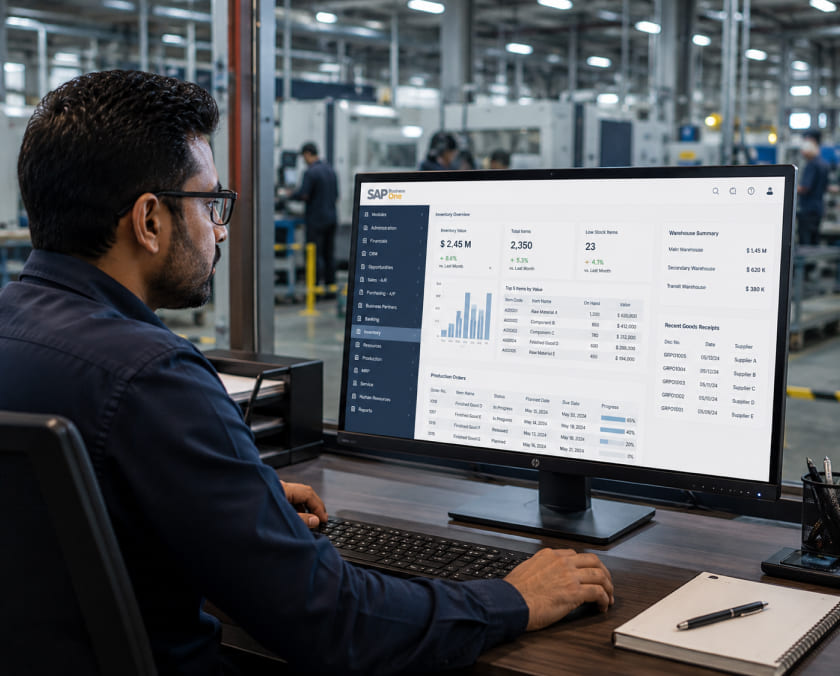
SAP Business One is built specifically for manufacturing and distribution companies with production planning and inventory requirements simpler platforms cannot match. Most implementations configure a fraction of what the platform actually offers.
Companies choose SAP Business One because their production or inventory complexity genuinely exceeds what Dynamics 365, NetSuite, or Odoo can handle cleanly. The platform delivers on that promise. What most implementations miss is configuring the deeper production planning, quality management, and multi-location inventory features that justify the higher cost and smaller partner ecosystem in the first place. Dotlogics configures SAP Business One around the actual complexity it was chosen to handle.


of ERP implementations do not deliver the expected results. Not because of the platform. Because the system was configured around defaults instead of how the business actually operates.
Gartner ERP Research
SAP Business One implementations that configure only basic financials and inventory leave the production planning depth unused, the exact reason the platform was chosen.
Companies select SAP Business One specifically because their production planning, quality management, or multi-location inventory needs exceed what simpler platforms handle. That is a deliberate, well-founded choice. The gap shows up after go-live, in three consistent patterns.
Dotlogics starts every SAP Business One engagement by confirming what the platform was actually chosen to solve, then builds the production planning, quality management, and reporting depth that matches that reason.

Every SAP Business One engagement starts with the production or inventory complexity that led the business to this platform in the first place.
Full implementation scoped around the specific production planning, quality management, or inventory complexity that led the business to choose SAP Business One.
Auditing an existing SAP Business One instance that is running on basic configuration and building out the deeper capability the platform was chosen for.
Configuring SAP Business One for companies managing multiple warehouses, production facilities, or legal entities.
Connecting SAP Business One to the CRM, ecommerce platform, and shop floor equipment in the business's stack
Results

ERP and Systems Integration
A wholesale hardware distributor was running on a basic SAP Business One configuration that handled financials but left multi-location inventory reconciled manually every week, requiring three people two full days. After configuring the platform's multi-location inventory and reporting capability fully, reconciliation dropped to under two hours and order processing capacity increased by 60% without adding headcount.
Very common. Many implementations configure financials and basic inventory correctly but never build out the production planning and quality management depth that was the actual reason for choosing this platform. An audit typically finds significant unused capability already included in the license.
A SAP Business One implementation typically costs between $80,000 and $300,000 depending on production complexity, number of locations, and integrations. Perpetual licensing starts at approximately $3,000 per user, with subscription licensing available at approximately $94 per user per month.
SAP Business One has a smaller partner ecosystem than Dynamics 365 or NetSuite, which means less competition and more variance in partner quality. Verifying real manufacturing or distribution implementation experience, not just platform certification, matters more here than with more widely implemented platforms.
Yes. Multi-location configuration with facility-level production planning and inventory is a core capability, though it requires deliberate configuration to work correctly across sites rather than treating each facility as an afterthought.
SAP Business One generally has stronger native manufacturing functionality out of the box. Dynamics 365 is often the better choice if the business is already on the Microsoft stack and values Power BI reporting integration. The decision usually comes down to production complexity versus existing technology investment.
Through a combination of APIs, middleware, and industrial protocols like OPC-UA or MQTT depending on the equipment. Modern SAP Business One implementations have established patterns for this, though older shop floor equipment may need a middleware layer.
Almost never. SAP Business One's native reporting can handle complex production and inventory data. The gap is usually that reports were never configured beyond default templates to match the business's actual production metrics.
A SAP Business One implementation typically takes four to eight months depending on production complexity, number of facilities, and integration requirements.
Yes. Quality management integration, including inspection workflows and compliance documentation, is one of the platform's core strengths for manufacturers in regulated industries, though it requires proper configuration during implementation.
SAP Business One was selected for a reason: production complexity or inventory requirements other platforms could not handle. The engagement makes sure that capability is actually built, not left as unused license.