

Our Services
All the solutions you need to accelerate growth and drive business success.
All the solutions you need to accelerate growth and drive business success.
BigCommerce Services
BigCommerce's native multi-channel selling and B2B capabilities are stronger than Shopify out of the box. Those advantages only matter if the implementation actually uses them.
BigCommerce is the platform ecommerce brands choose when they want Shopify-level ease of management with stronger native B2B capabilities and more open APIs for integration. The brands that get the most from BigCommerce built the implementation around how the business actually sells: across multiple channels, to multiple customer types, connected to the inventory and fulfillment operation behind the store. Dotlogics builds BigCommerce stores that do all of that.



Of software features are rarely or never used.
Standish Group Research
BigCommerce stores that never connect native multi-channel selling or configure real B2B pricing are leaving most of that sitting unused.
The most common BigCommerce problem is not what the platform cannot do. It is what the implementation never enabled. The gap shows up in three consistent patterns.
Dotlogics brings specific BigCommerce expertise to every engagement: multi-channel setup that actually connects, B2B configuration that reflects real pricing, and custom development that replaces app-ecosystem gaps.

Every BigCommerce engagement starts with mapping how the business sells and what the current store is not doing that it should.
Building what the business needs beyond available themes and apps. Custom Stencil theme development, custom widgets, and custom checkout flows built for conversion and performance.
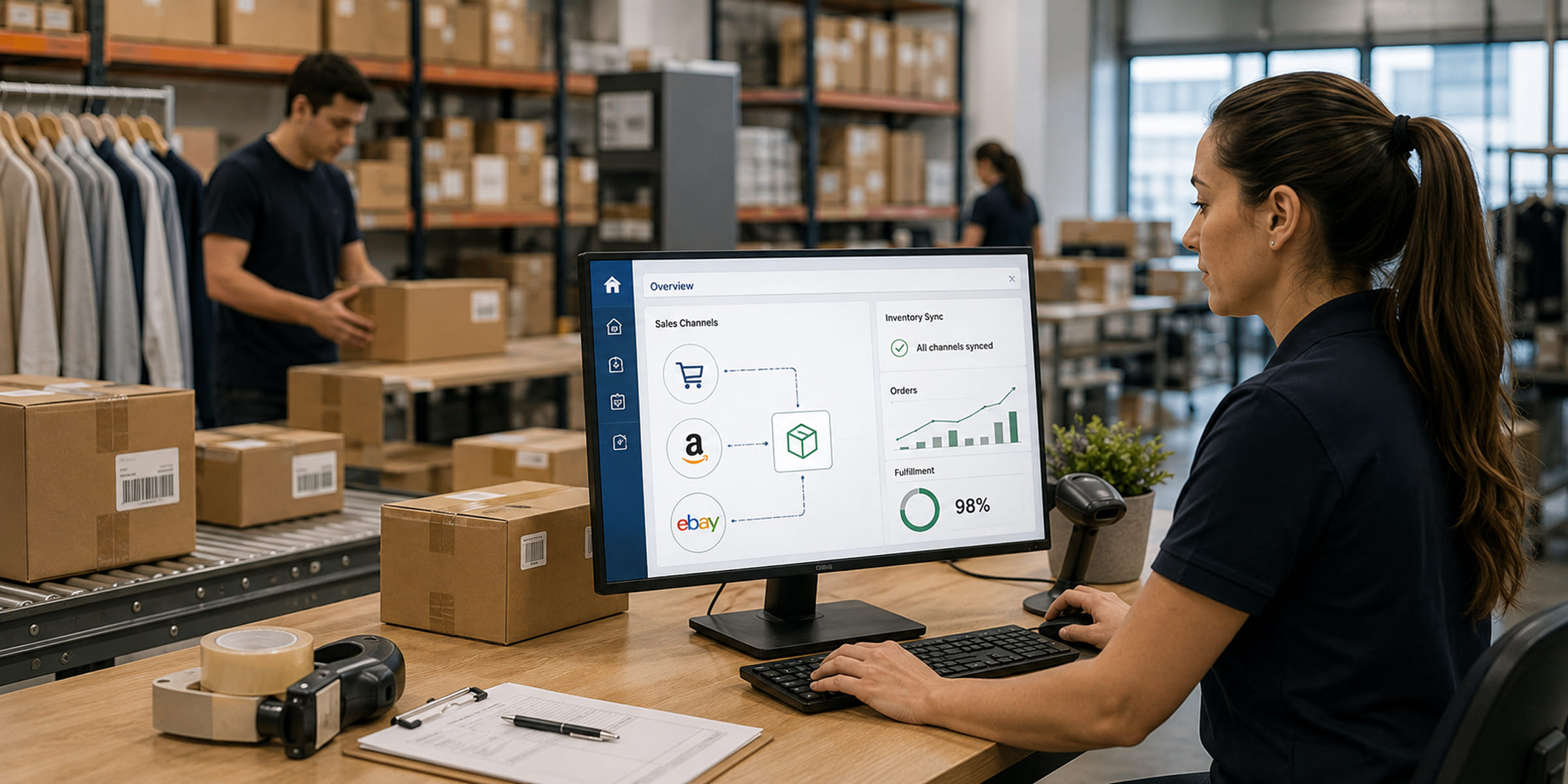
Connecting BigCommerce to the sales channels where the business sells: Amazon, eBay, Google Shopping, Facebook, and Instagram. Inventory and order management across all channels from one backend, without manual reconciliation between them.
BigCommerce's native B2B capabilities include customer group pricing, purchase order payment, quantity-based pricing, and quoting. Configuring these correctly for the specific B2B operation requires understanding how the business actually sells to different account types, not just setting up the platform defaults.
Connecting BigCommerce to the ERP, inventory system, and fulfillment operation so that product data, stock levels, and orders flow automatically between the store and the business behind it.
Both platforms are well-supported and used by thousands of ecommerce brands. Where BigCommerce is stronger: native multi-channel selling across Amazon, eBay, and social commerce without third-party apps. Stronger out-of-the-box B2B capabilities including customer group pricing, purchase orders, and quoting without expensive add-ons. No transaction fees on any payment gateway. Open APIs with more flexibility for custom integrations.
Where Shopify is stronger: Shopify Plus gives access to the checkout source code, which BigCommerce does not. The Shopify app ecosystem is larger. For brands that need the deepest level of checkout customization or the widest app ecosystem, Shopify Plus is the better choice.
For multi-channel sellers and B2B brands that do not need checkout source code access, BigCommerce often offers better total cost of ownership. Dotlogics evaluates both before recommending one.
Results
Ecommerce Development
A multi-channel retailer selling across their own store, Amazon, and eBay was reconciling inventory manually across platforms every morning. After connecting BigCommerce to all three channels with automatic inventory sync and centralized order management, the manual reconciliation was eliminated. The team recovered several hours per day previously spent on cross-platform data entry and fulfillment errors dropped significantly.
Yes. BigCommerce's Stencil framework, API structure, and B2B configuration are different enough from Shopify that genuine BigCommerce expertise matters. An agency that primarily does Shopify work and occasionally does BigCommerce will produce work that reflects that. Dotlogics has built BigCommerce stores specifically for brands with multi-channel and B2B requirements.
BigCommerce underperformance usually traces to one of three causes: an unoptimized Stencil theme that is slow on mobile, multi-channel integrations that are out of sync and causing inventory errors, or B2B configuration that was set up generically rather than for the specific customer types the business serves. A store audit identifies which applies and what fixing it requires.
Sometimes. The migration makes sense if the specific limitations of BigCommerce, usually the smaller app ecosystem or the lack of checkout source code access, are directly costing revenue. It does not make sense purely because Shopify is more popular. A migration assessment covers what is lost, what is gained, and whether the move is worth the disruption and cost.
A BigCommerce implementation typically costs between $20,000 and $120,000 depending on the level of custom development, the number of channel integrations, and whether a migration from another platform is involved. BigCommerce licensing ranges from $299 to $1,000 per month for standard plans. Enterprise pricing for high-volume stores is negotiated directly with BigCommerce.
BigCommerce has stronger native B2B capabilities than Shopify, including customer group pricing, purchase order payment, quantity-based pricing, and a quoting system. These are available without third-party apps, which reduces cost and complexity. For B2B brands that do not need the deep catalog management of Magento or Adobe Commerce, BigCommerce is a strong platform choice.
BigCommerce has stronger native multi-channel selling capabilities out of the box. It connects to Amazon, eBay, Google Shopping, Facebook, and Instagram with automatic inventory sync and centralized order management without requiring third-party apps. Shopify requires apps to achieve the same multi-channel management, which adds cost and introduces integration maintenance requirements.
BigCommerce has solid built-in SEO and AI SEO capabilities including URL customization, meta data management, and automatic sitemap generation. For migrations to BigCommerce from another platform, SEO and AI SEO preservation requires mapping existing URLs, implementing 301 redirects, and verifying indexing before the old site is taken offline. Brands that skip this step consistently lose organic traffic and AI search visibility.
Yes. BigCommerce is a popular choice for headless commerce because of its open APIs. A headless implementation separates the front-end presentation layer from the back-end commerce engine, which allows more flexibility in how the store looks and performs. Headless adds significant complexity and is only worth it when the business has a genuine need for that flexibility and the technical resources to manage it.
BigCommerce handles hosting, security patches, and core platform updates as part of the monthly licensing fee, which is one of its advantages over Magento and WooCommerce. Ongoing maintenance for a BigCommerce store focuses on theme updates, app updates, integration monitoring, and performance optimization as the catalog and traffic grow. The maintenance burden is lower than self-hosted platforms.
The multi-channel capability and B2B features that make BigCommerce worth choosing are only valuable when they are configured correctly and connected to the inventory and fulfillment operation behind the store. That is what the implementation delivers.