

Our Services
All the solutions you need to accelerate growth and drive business success.
Global teams trained in generative AI workflows this year alone.

Why AI adoption is harder than it looks
Buying the software is easy. Changing how people work is where most digital transformations fail.
Tool Overload
Teams are paralyzed by too many options and no clear direction on what to use when.
Security Risks
Unstructured usage leads to sensitive company data being fed into public models.
Low Adoption
Without proper training, employees revert to old, manual habits within weeks.
Prompt Fatigue
Generic prompting produces generic results, leading to a loss of faith in AI capabilities.
Missing ROI
Companies invest in seats but fail to measure actual productivity gains or cost savings.
What custom AI agents help you eliminate
Eliminate repetitive manual tasks
Eliminate process bottlenecks
Eliminate delays caused by disconnected workflows
Eliminate unnecessary handoffs across teams
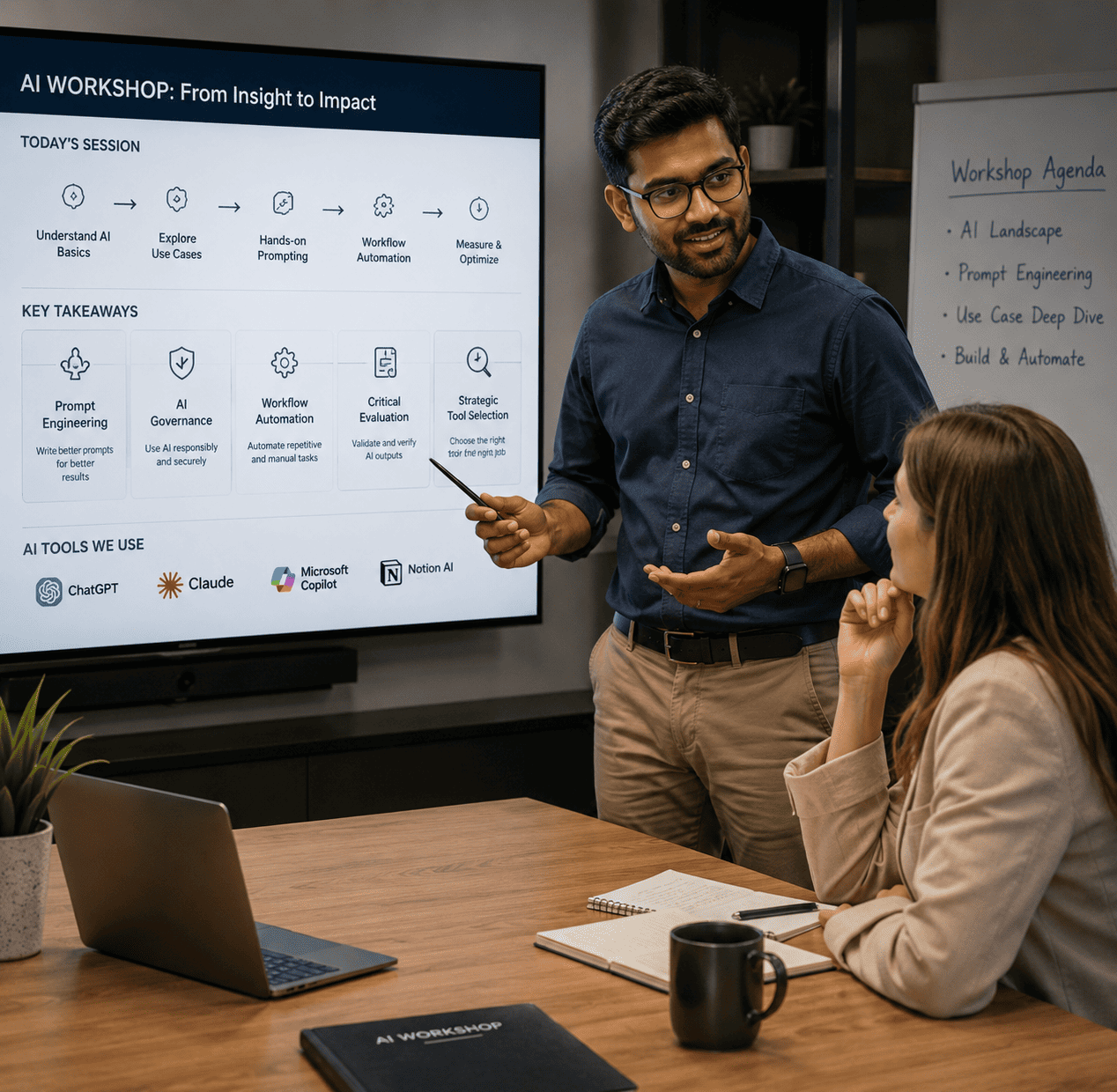
Department-specific workshops
Generic training doesn't work. We tailor our curriculum to the unique workflows of each functional team.
HR & Talent
Automate candidate screening, draft complex policies, and personalize employee engagement at scale.
Sales
Personalize outbound at volume, automate CRM updates, and use AI for real-time deal intelligence.
Marketing
Generate high-quality content variants, optimize SEO strategy, and scale creative production processes.
Finance
Automate data extraction, improve forecasting accuracy, and streamline monthly reconciliation reports.
Operations
Map and automate repetitive manual workflows, reducing bottlenecks across the entire organization.
Customer Service
Implement AI assistants for first-tier support and equip agents with real-time knowledge base retrieval.
How we deliver successful AI adoption
We don't just show up and talk. We build a repeatable system for your team to master these tools.
01
Understand workflows & select tools
We audit your current manual processes to identify where AI can provide the highest leverage and select the right stack for your goals.
02
Instructor-led training
Live, interactive sessions where your team works on real-world business problems using AI tools in a secure environment.
03
Monitor adoption & improve results
Post-training support and analytics to ensure the new workflows are sticking and delivering the expected productivity gains.
Increased Efficiency

Reduced
Operational Costs
What your team will gain
Mastery of Prompt Engineering
Move beyond 'write an email' to complex multi-step reasoning chains.
Secure AI Governance
Strict protocols on what data can be shared and how to maintain privacy.
Workflow Automation Frameworks
Ability to identify and bridge gaps between manual and automated tasks.
Critical Evaluation of Outputs
Training on how to spot hallucinations and verify AI-generated data.
Strategic Tool Selection
Understanding which model (Claude vs GPT-4) is best for specific tasks.
Confidence in the Age of AI
Empowerment of your staff to see AI as a partner, not a replacement.
Integrating with the world's most powerful AI systems







The Training Curriculum
MODULE 01
AI Foundations & Ethics
Understanding LLMs, data privacy, and the current landscape of generative tools.
MODULE 02
Advanced Prompt Design
Mastering personas, constraints, and chain-of-thought techniques for precision results.
MODULE 03
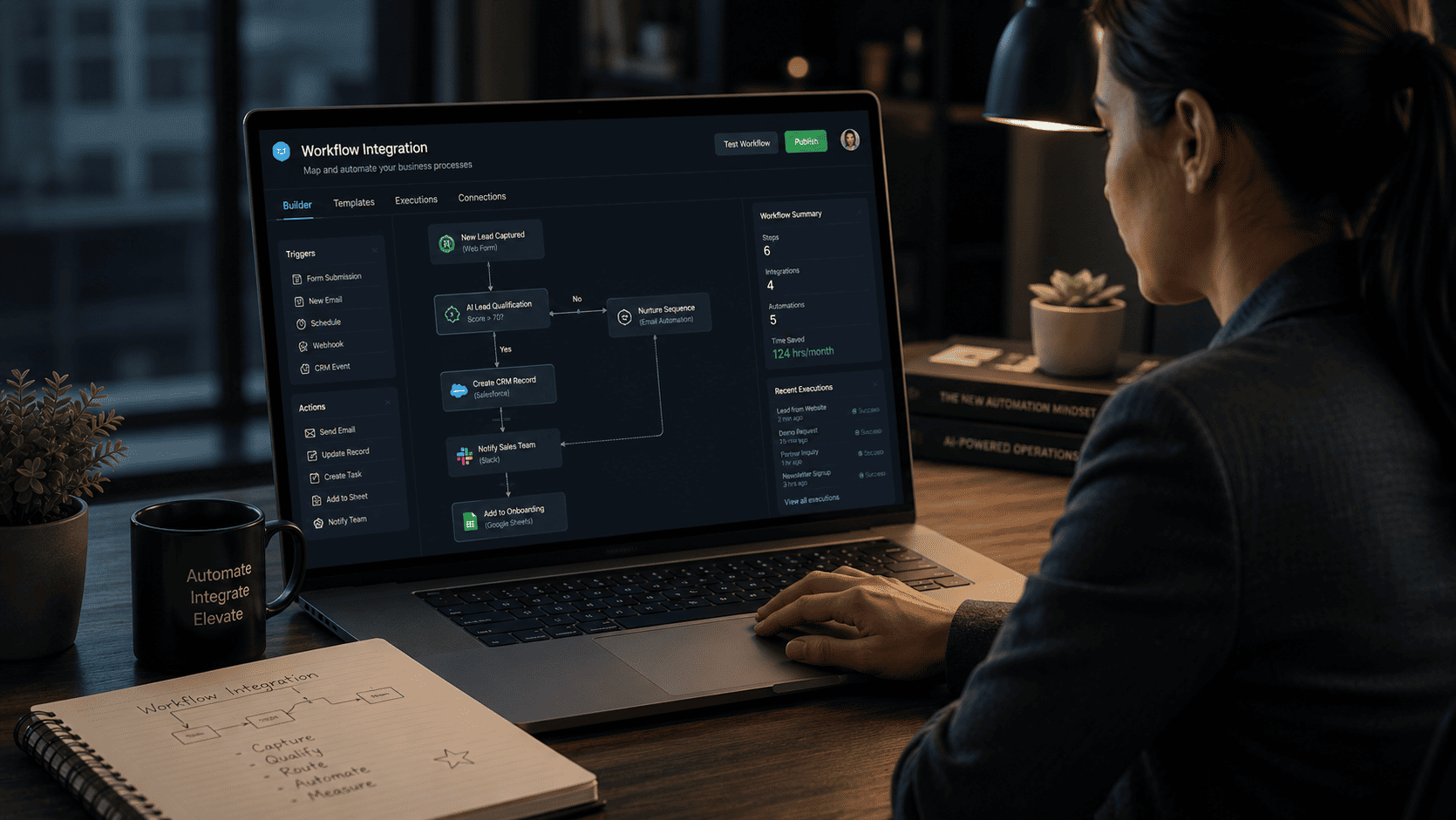
Workflow Integration
Mapping your existing business processes to AI-enhanced automated workflows.
MODULE 04
Data & Analysis
Using AI to interpret complex spreadsheets, synthesize reports, and find trends.
MODULE 05
Content & Creativity
Scaling high-quality output without losing your brand's unique human voice.
MODULE 06
Custom Agent Building
Introduction to building custom GPTs and agents for recurring internal tasks.
Why businesses bring in Dotlogics
We focus on the human side of the technology equation.
Technical Authority
We are practitioners, not theorists. Our training is built on actual engineering implementation.
Custom Curriculum
No generic decks. We build workshops around your specific tools and data policies.
Speed to Value
Our goal is to have your team applying new skills by the following Monday morning.
Security Focused
We prioritize data privacy and risk management throughout every module.
Post-Training Audit
We follow up to see what stuck and where more guidance might be needed.
Ongoing Support
Access to our expert pool for technical questions long after the workshop ends.
Frequently Asked Questions
Clear answers to common questions about implementation, integrations, and how our solution fits your business. Still have questions? Feel free to contact our support
Dotlogics AI training workshops are structured, department-specific training programs that help business teams master AI tools — from prompt engineering and workflow automation to secure governance and measurable adoption. Over 150 global teams have been trained this year alone.
AI adoption fails because of tool overload, security risks from unstructured usage, low adoption without proper training, prompt fatigue from generic approaches, and missing ROI from seats that go unused.
Dotlogics delivers AI training workshops for HR and Talent, Sales, Marketing, Finance, Operations, and Customer Service teams — each tailored to the specific workflows and challenges of that department.