Key Highlights

  • Backend systems, not just UX design, determine whether customers can actually complete a purchase during peak traffic

  • Real-time inventory orchestration requires event-driven architecture. Batch syncing creates overselling and cancellations

  • Mobile conversion lags 30 to 40% behind desktop primarily due to system latency, not screen size

  • Integration security and failover planning are operational requirements in 2026, not edge cases

  • AI personalization fails when built on fragmented data across disconnected systems

If your ecommerce team is still treating performance issues as just a website design problem, you might be looking at the wrong layer of your stack.

In 2026, most conversations about digital commerce focus on AI recommendations, personalization engines, and conversion rate tactics. But IT leaders often see a different picture. When checkout fails during a flash sale, when inventory shows items in stock that aren't actually available, when mobile performance drops under heavy traffic, these typically aren't user experience problems. They're backend system problems.

Your ecommerce platform's performance is set by your backend architecture, not just your homepage redesign.

The Real Problem: Integration Debt at Scale

Most established ecommerce operations run on a patchwork of systems that were never designed to work together in real time.

Here's what that typically looks like:

  • Your ERP manages inventory on one schedule

  • Your order management system processes orders on another

  • Your CRM holds customer data that may or may not match what your payment gateway sees

  • Each system speaks a different API language

  • Everything syncs on different intervals

  • Basic concepts like "customer" or "product" are defined differently across platforms

This isn't a vendor problem or a talent problem. It's an architectural reality that emerged organically as businesses grew, acquired competitors, or simply made pragmatic decisions year after year.

The Daily Operational Cost

The impact shows up in ways that directly affect your bottom line:

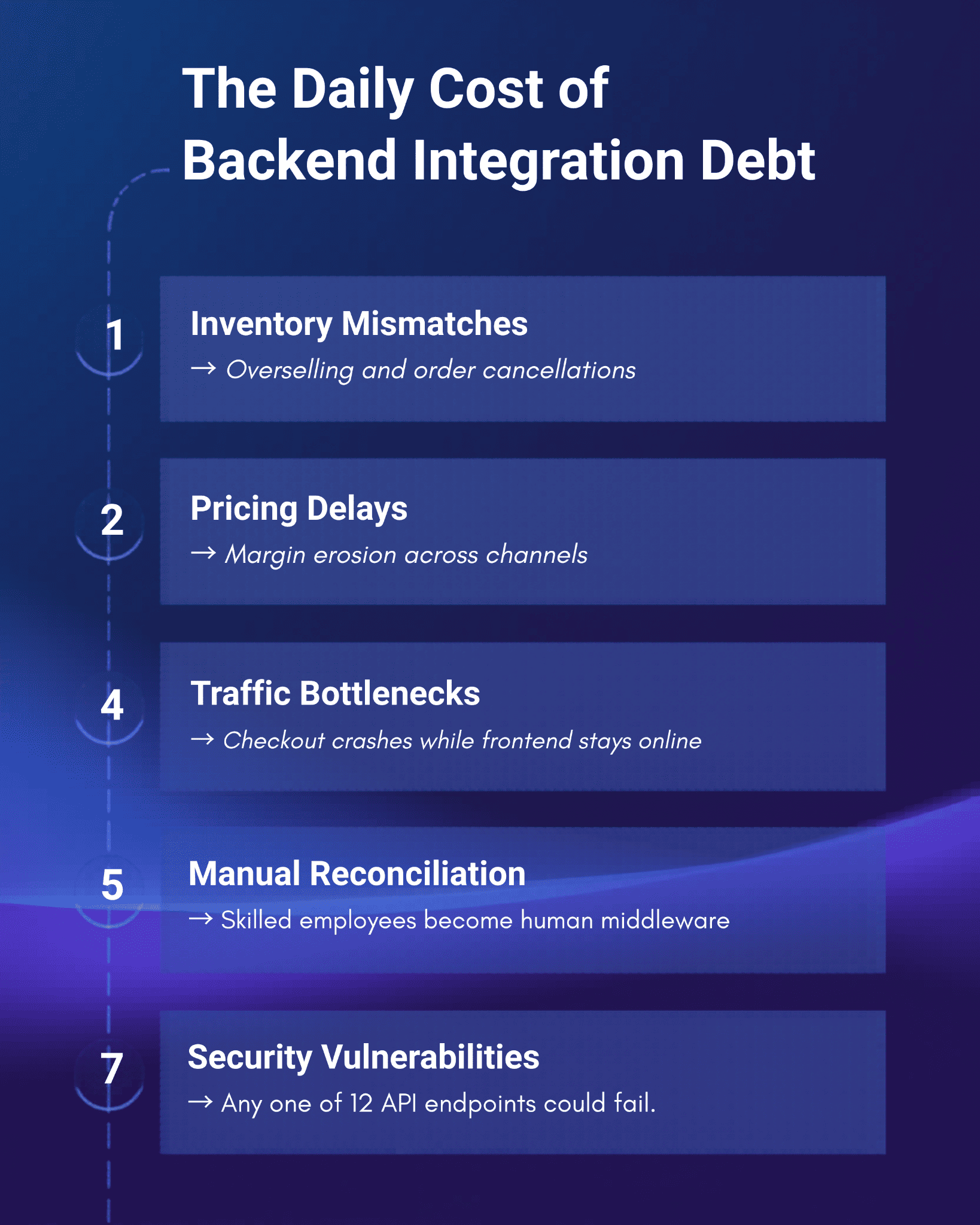
Inventory Mismatches
Inventory displayed as available on the frontend doesn't match warehouse reality. 

Result: overselling and order cancellations that damage customer trust.

Pricing Delays
Pricing changes take hours to propagate across channels. 

Result: margin erosion or customer service escalations when shoppers catch the discrepancy.

Traffic Bottlenecks
Traffic spikes expose integration bottlenecks that crash checkout flows while the frontend stays perfectly online. 

Result: customers think your site is broken.

Manual Reconciliation
Teams spend their days resolving data conflicts between systems that should be talking directly to each other. 

Result: skilled employees become human middleware.

Security Vulnerabilities
Security audits reveal vulnerability surfaces across six different authentication models and twelve API endpoints. 

Result: any one could be the weak link.

The Hidden Cost: When a promotion drives unexpected traffic and your order management system can't keep pace with payment processing, you don't just lose conversions. You lose customer trust, marketplace search rankings, and team confidence.

Why the Common Fixes Keep Failing

The natural instinct is to optimize what's visible:

  • Improve page load times

  • A/B test checkout flows

  • Deploy smarter product recommendations

These aren't wrong moves. They're just incomplete.

Conversion rate optimization assumes the systems underneath can deliver what the frontend promises.

When they can't, you're not solving a marketing problem. You're masking a reliability problem.

The Composable Commerce Trap

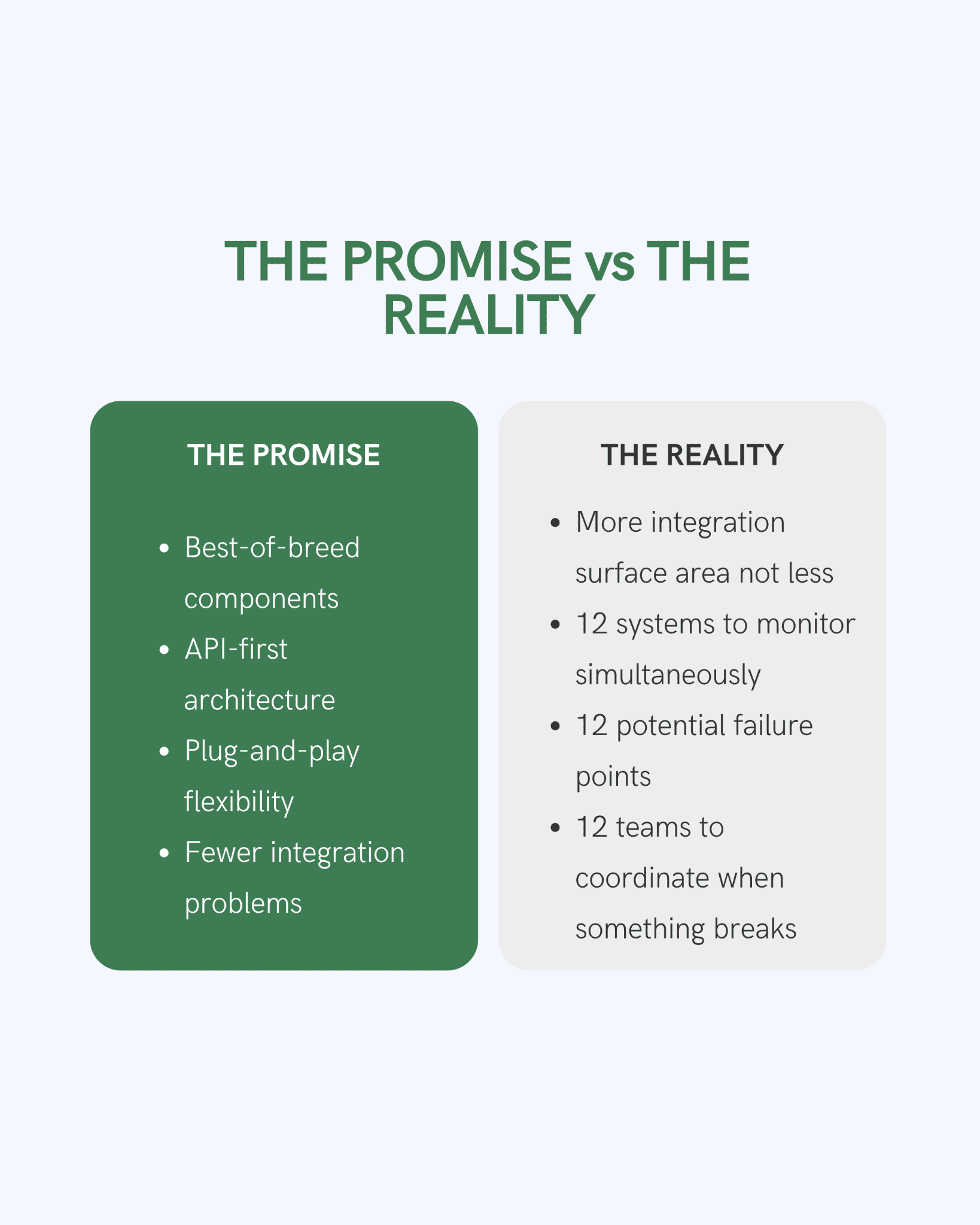
The composable commerce narrative promised a better path:

  • Best of breed components

  • API first architecture

  • Plug and play flexibility

The promise is real, but the execution is more challenging than the pitch decks suggest.

Composability without strong middleware, event-driven orchestration, and unified data governance creates more integration surface area, not less. You've traded one monolith for twelve microservices that still don't share a consistent view of inventory.

Now you have:

  • Twelve systems to monitor

  • Twelve potential failure points

  • Twelve different teams who need to coordinate when something breaks

The AI Data Foundation Problem

AI powered personalization is getting a lot of attention right now, and for good reason. But AI effectiveness depends entirely on unified, real-time data pipelines.

Consider what happens when your data is fragmented:

  • Product catalog is inconsistent across systems

  • Customer behavior data is siloed in three different platforms

  • Pricing engine doesn't know what inventory system knows

  • AI trains on incomplete or contradictory information

The result? Your AI makes recommendations based on products that aren't available, prices that aren't current, and customer preferences that aren't accurate.

Adding AI on top of fragmented data doesn't create intelligence. It creates expensive noise.

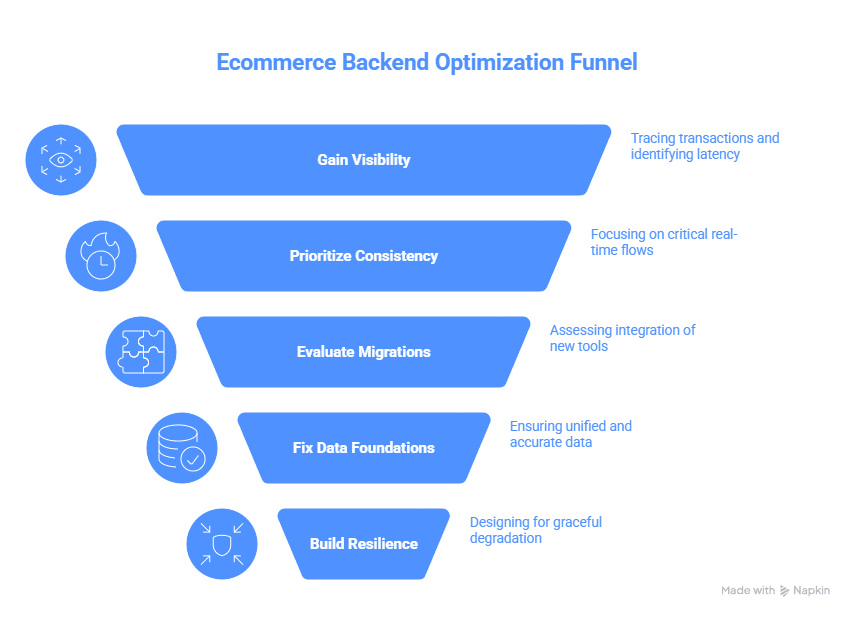
Practical Direction: What Credible Optimization Looks Like

You don't need to rebuild everything from scratch. You need to identify where system constraints are limiting business outcomes, then address those constraints in order of impact.

1. Start with Visibility

If you can't trace a transaction end-to-end, you're operating blind.

What visibility looks like:

  • Frontend click

  • Payment confirmation

  • Warehouse fulfillment

  • Every system handoff

  • Every latency spike

  • Every retry

Observability isn't a nice-to-have feature. It's how you diagnose whether slow checkout is a frontend problem, a network problem, or a backend integration problem.

2. Prioritize Real-Time Consistency Strategically

Not everything needs to be real-time, but the high impact touchpoints do.

Where real-time matters most:

Flash Sales and High Traffic Events
Inventory accuracy is critical when you're moving hundreds of units per minute. Batch updates will cost you in oversells and cancellations.

Cross-Channel Pricing
Pricing consistency matters most where customers actively compare. If your mobile app shows one price and your website shows another, customers notice.

Checkout Flows
Payment processing, fraud checks, and order confirmation need immediate system responses.

Focus your real-time investment where it directly impacts customer experience and revenue outcomes.

3. Evaluate Composable Migrations on Integration Maturity

A new service is only as good as its ability to reliably communicate with your existing systems.

When evaluating new tools, ask:

  • How does it integrate with our current order management system?

  • What happens when the integration fails?

  • Can it handle our peak traffic volumes?

  • Does it support our data governance requirements?

If the integration layer isn't production ready, the migration creates more risk than value.

4. Fix Data Foundations Before AI Initiatives

AI is only as good as the data you give it.

If you're investing in personalization or recommendation engines, first ensure:

  • Product catalog has no duplicate records

  • Categorization is consistent across systems

  • Attribute updates happen in real time

  • Customer data is unified and accurate

AI accelerates failure when the underlying data is unreliable. It will confidently recommend products that don't exist, suggest prices that aren't current, and target customers based on incomplete profiles.

5. Build Failure Resilience Into Critical Workflows

Design for graceful degradation, not perfect uptime.

Practical examples:

Shipping Rate APIs
If a third party shipping rate API goes down, your checkout shouldn't crash. Fall back to estimated rates and complete the transaction. You can reconcile the actual shipping cost later.

Fraud Detection Services
If your fraud detection service times out, have a decision tree:

  • Approve low risk transactions automatically

  • Flag high risk ones for manual review

  • Don't block everyone while waiting for a service to respond

Payment Processors
Have backup payment processors configured and ready to activate if your primary goes down.


Perfect uptime doesn't exist. What exists is systems that handle failure well and systems that don't.

The Outcome: Systems That Support Growth

The businesses that thrive in competitive ecommerce markets are the ones whose systems can reliably deliver what the frontend promises.

When your backend architecture is sound:

  • Inventory is accurate in real time

  • Checkout can handle traffic spikes without degrading

  • New services can integrate without brittle custom code

  • Failures are contained and routed around

  • Frontend optimization work actually compounds

This enables you to:

  • Run aggressive promotions confidently

  • Expand to new channels without creating operational chaos

  • Adopt new technologies without breaking existing flows

  • Scale revenue without scaling problems

The performance ceiling rises when the foundation can support the weight.

Conclusion

This isn't about chasing the latest platform trend or betting on a single vendor's vision. It's about building integration layers that are resilient, observable, and flexible enough to adapt as business requirements change.

The path forward:

  1. Treat data consistency as an operational priority

  2. Invest in system reliability before adding new features

  3. Build observability into every integration

  4. Design for failure from the start

  5. Focus on the constraints that limit growth

The frontend is what customers see. The backend is what determines whether they can complete a purchase, trust the information you show them, and come back for more.

In 2026, ecommerce optimization is fundamentally a systems problem. The businesses that recognize this reality are the ones building platforms that can actually scale.

Frequently asked questions

Look for operational signals, not just conversion metrics. Rising order cancellations, inventory mismatches, payment retries, checkout timeouts during traffic spikes, and increased manual reconciliation are strong indicators that backend integration is impacting sales performance.

Real-time data inconsistency between storefront, OMS, ERP, and payment systems is the most common issue. When systems update on different schedules, customers see inaccurate inventory, delayed confirmations, or pricing discrepancies that damage trust.

No. Page speed improvements address frontend delivery, not system orchestration. If integrations between inventory, pricing, and payment systems are slow or unreliable, optimizing visual load times alone will not prevent checkout failures.

Not by default. Composable architectures increase flexibility but also increase integration surface area. Without strong middleware, event-driven coordination, and unified data governance, composability can create more failure points instead of fewer.

No. AI systems rely on unified, accurate, real-time data. If product catalogs, pricing engines, and customer profiles are inconsistent, AI will generate unreliable recommendations and amplify system weaknesses.

It means critical workflows such as inventory updates, payment confirmation, pricing validation, and order creation update instantly across systems rather than syncing in scheduled batches. Real-time consistency prevents overselling and checkout friction.

Start with transaction visibility and observability. Identify latency bottlenecks, integration failure points, and data inconsistencies. Fix constraints that directly impact revenue before investing in new frontend features or AI initiatives.

Reliable backend systems allow confident promotion launches, smoother traffic scaling, faster integration of new services, and consistent customer experiences across channels. When the foundation is stable, growth initiatives compound instead of break.