

Our Services
All the solutions you need to accelerate growth and drive business success.
All the solutions you need to accelerate growth and drive business success.
ERP for Healthcare
Healthcare organizations have more operational complexity than most industries and less tolerance for system failures. The ERP has to support both without creating new friction.
Dotlogics helps healthcare operations leaders implement ERP systems configured around healthcare-specific requirements: billing integration, regulatory compliance, medical supply inventory, and the operational processes that keep patients moving through the system.


Where Healthcare ERP Falls Short
Regardless of platform, these are the issues that come up most often when healthcare ERP implementations do not deliver what they should.
Most healthcare organizations run their EHR or practice management system separately from their financial system. Reconciling the two requires manual work that consumes finance team hours every week and creates a consistent source of billing errors.
Hospitals, clinics, and healthcare facilities carry significant inventory of medical supplies, medications, and equipment. When this inventory is not connected to the ERP, stockouts and overstock both happen regularly and neither is visible until the problem is acute.
Healthcare organizations operate under HIPAA, Joint Commission standards, and various state and federal regulations. ERP systems that were not configured with compliance documentation in mind require manual workarounds to generate the reports that regulators need.
Healthcare groups managing multiple practices, clinics, or facilities often run each location's financials separately. Consolidation requires manual effort. Comparing performance across locations requires building reports that should come standard.
Platform Options
We are neutral advisors. We do not earn more when you choose one platform over another. Healthcare's platform fit looks different from other industries: heavy manufacturing-oriented systems are rarely the right answer here, so the platforms we recommend most often are the ones with the strongest financial, compliance, and multi-entity capabilities.






How We Help
Every engagement starts with your billing, compliance, and inventory requirements before anyone touches the system.
Connecting the ERP to the practice management or EHR system so that billing data flows automatically into the financial system. Reconciliation becomes a confirmation rather than a manual process.
Configuring the ERP to manage medical supply inventory with the same accuracy as the financial system. Reorder points, expiration tracking, and usage by department.
For healthcare groups managing multiple practices or facilities, consolidating financials across all entities in one system with proper inter-entity accounting.
Configuring the ERP to generate the documentation and audit trails that healthcare regulatory requirements demand, without creating additional administrative work for the operations team.
Results
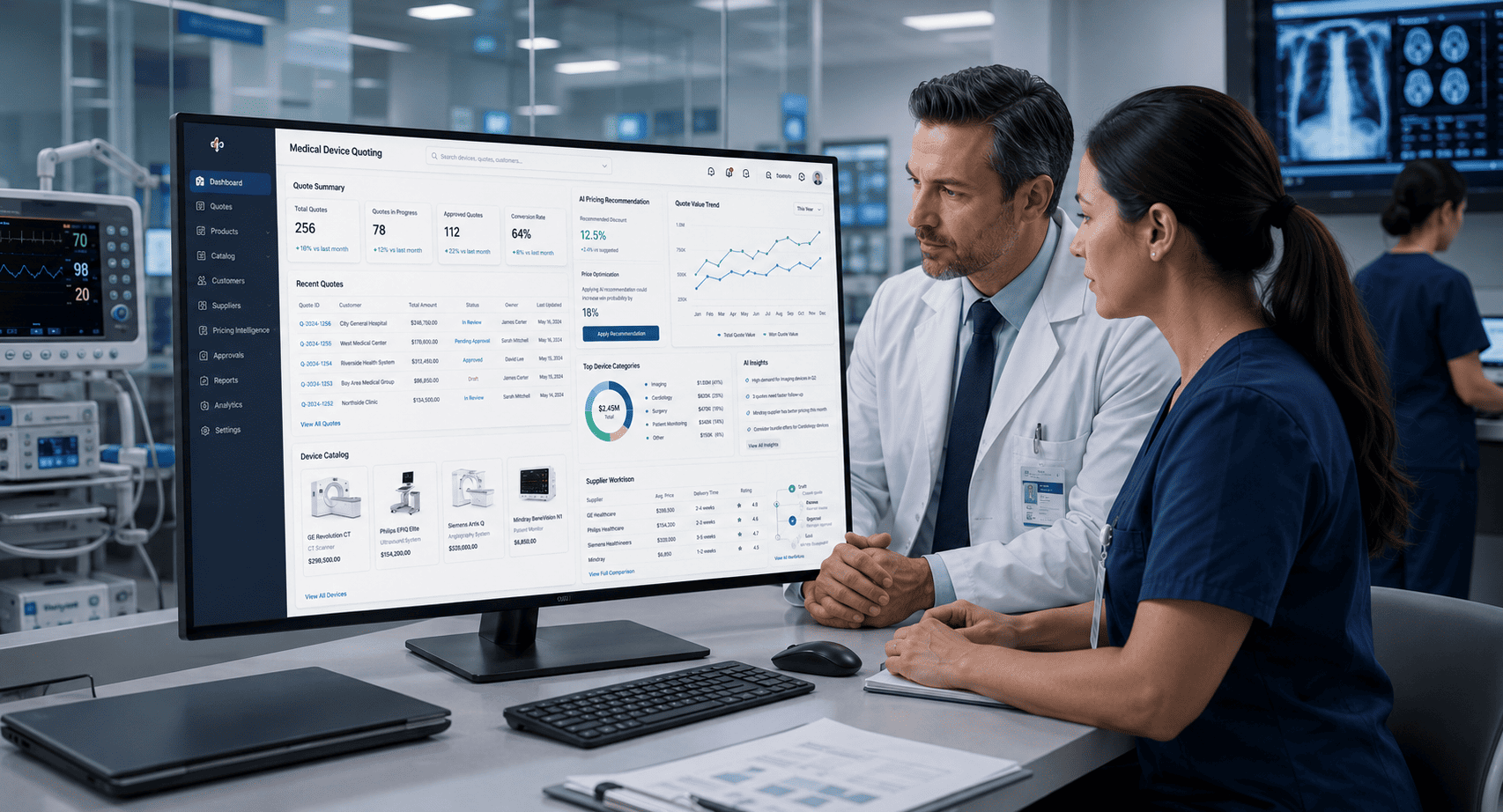
AI-Powered ERP Integration
A medical device company was managing quotes manually across sales, finance, and operations, with no connection between the quoting process and the ERP. After building an AI-powered quoting engine integrated directly with the ERP, quote turnaround dropped to under 30 minutes and the team recovered 12 hours per week previously spent on manual coordination.
Common Questions
An EHR manages clinical operations and patient records. An ERP manages financials, inventory, purchasing, and multi-entity operations. Most healthcare organizations need both. The question is how well they connect. An ERP that integrates with the existing EHR eliminates the manual reconciliation that currently runs between the two systems.
HIPAA compliance in ERP implementation covers data access controls, audit trails, and business associate agreements with any vendor handling protected health information. Dotlogics configures ERP systems with these requirements in mind and ensures the systems integrated with the ERP handle data appropriately.
No ERP is built specifically for clinical operations. That is the EHR's job. An ERP handles the operational and financial side of running a healthcare organization. The healthcare-specific requirements are in billing integration, supply inventory, multi-entity financials, and compliance documentation, all of which are configurable in the right ERP platform.
Healthcare organizations most commonly use Microsoft Dynamics 365 Business Central, NetSuite, or Odoo for financial management, inventory, and multi-entity operations. The choice depends on organization size, whether it manages multiple entities, and the integration needed with the existing EHR.
An ERP system helps healthcare organizations by connecting financial management, medical supply inventory, purchasing, and multi-entity operations in one system. The primary benefit is eliminating manual reconciliation between the clinical system and the financial system.
An EHR manages clinical operations: patient records, clinical documentation, scheduling, and clinical billing. An ERP manages operational and financial operations: general ledger, accounts payable, purchasing, inventory, and multi-entity financials. Most healthcare organizations need both, connected.
A single-site medical practice typically manages with a practice management system or EHR that includes basic financial management. An ERP becomes relevant when the practice manages multiple locations, has significant medical supply inventory, needs multi-entity financial consolidation, or has outgrown the financial capabilities of the practice management system.
A healthcare ERP implementation typically takes four to nine months depending on the number of entities involved, the depth of EHR integration required, and the compliance documentation needs specific to the organization.
Yes, this is a standard requirement for healthcare ERP configuration. Insurance billing, private pay, and institutional or wholesale billing can be configured to run through the same financial system, though each requires its own workflow mapped during discovery.
Billing that reconciles automatically. Supply inventory that reflects what is actually on the shelf. Financial reports that cover all locations without manual assembly. An ERP configured around healthcare operations delivers all three. That is what the engagement is built around.